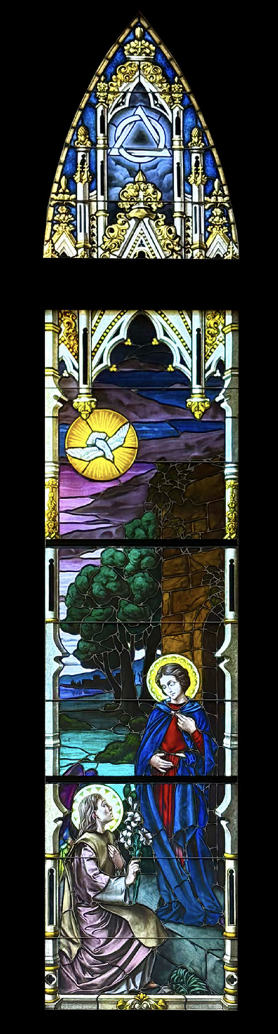
Salvation History In Stained Glass
Welcome to St Francis Xavier Catholic Church and the story of Salvation History told in stained glass. As you step into the church, laid out in the shape of a cross, your gaze is drawn to the crucified figure of Christ. Along the nave, a majestic series of stained glass windows narrate the story of salvation history. To your left, as you face the altar, the journey begins with the creation account, illustrating the profound truth that God created us out of love and invited us to share in His divine life in a state of grace. Yet shortly after God’s covenant with creation, Adam and Eve fall into sin and reject God’s grace. God, in His infinite mercy, immediately instituted His plan of salvation, beginning with the Proto-Evangelium in Gen 3:15, where God promises that the offspring of the Woman will crush the serpent’s head, foreshadowing Christ’s victory over sin and death. The narrative continues through the Old Testament covenants: with Noah, Abraham, Moses, and David, each window capturing pivotal moments of divine promise, culminating in their fulfillment in the New Covenant instituted at the Last Supper scene on the altar.
Opposite these, on the right side of the nave, the story of the New Creation comes alive. It begins with the Incarnation, then moves to the Nativity, Baptism of Jesus, Wedding at Cana, Sermon on the Mount and Palm Sunday, all leading to Holy Thursday, artistically illustrated on the altar. The windows on the right reveal rich typological connections to those on the left, such as the juxtaposition of the Flood with Christ’s baptism where Old Testament prophecy speaks to God cleansing us from original sin with clean water and Peter acclaims that the Flood was a pre-figuration of the saving power of Baptism. As St. Augustine insightfully observed, “The New Testament is concealed in the Old, and the Old Testament is revealed in the New.” These pairings underscore the unity of Scripture leading to the Last Supper highlighting Christ’s institution of the New Covenant, drawing together all the threads of God’s salvific plan.
The journey continues vertically, marking Holy Thursday’s transition to Good Friday with the crucifix, illustrating the profound sacrifice that transforms the cross into an instrument of redemption. Rising toward the ceiling, the story culminates in a resplendent rose window, depicting the Agnus Dei, the risen Lamb (Rv 5:6), surrounded by flowers associated with the Passion and Resurrection, signifying the victory of life over death. This central axis links the fulfillment of the Old and New Testaments in Jesus Christ, leading worshippers to contemplate the mystery of salvation, completed in His resurrection and celebrated in the Eucharist at every Mass.
Cost Breakdown
The opportunities shown here reflect the remaining amount needed to complete the full stained glass window series. Some may feel called to sponsor a window in full, while many others will help accomplish this sacred work through gifts of every size. It is through this shared generosity — each person giving according to his or her ability — that this lasting vision for St. Francis Xavier will be brought to completion.
Windows
Double Lancet Nave Windows
$175,000 each
14 windows total, 7 remaining to be sponsored
Rose Windows
$218,000 each
4 windows total, 2 remaining to be sponsored
Seraphim, Cherubim, 3 Archangels
$35,000 each
5 windows total, 5 remaining to be sponsored
Alpha, Omega, 4 Evangelists
$25,000 each
6 windows total, 6 remaining to be sponsored
Ways to Support
Your gift helps bring this sacred vision to life for future generations.
One-time Gift
via cash or checkThree-Year Pledge Commitment
Click here to download pledge form.Secure Online Giving
Click here.Stock / IRA / Donor Advised Gifts
Questions? Contact our Business Office at 405.372.6886.